The trade show known as BookExpo has just ended, showcasing the fall books, especially those for which publishers have spent lots of dough. George W. Bush (Crown), Tony Blair (Knopf), Maria Bartiromo (Penguin), and Bob Woodward (Simon and Schuster) all have big books coming, but they're unlikely to be the most interesting.
Provocative business titles include Hacking Work (Portfolio), in which consultants Bill Jensen and Josh Klein assume that many of your employer's rules are stupid and counterproductive. The authors tell you how to get around them and, as a result, be more productive.
Stanford professor Bob Sutton, author of the no-B.S. best-seller The No Asshole Rule, has a new common-sense work, Good Boss, Bad Boss: How to Be the Best…And Learn From the Worst (Business Plus). Sutton's blog is at http://bobsutton.typepad.com/
Former Wired editor Kevin Kelly offers What Technology Wants (Viking), which the publisher says will offer “a refreshing view of technology as a living force in the world.”
And Forbes writer Emily Lambert will have The Futures: The Rise of the Speculator and the Origins of the World’s Biggest Markets (Basic Books) detailing past and present doings at the Chicago Mercantile Exchange, “the original (and eventually largest) futures market.”
The topic of online social networking dominated the conversation at BookExpo, so naturally, there are many books on the topic. These include former Web executive Lisa Gansky’s The Mesh: Why the Future of Business is Sharing and Don Tapscott and Anthony D. Williams’ Macrowikinomics. Both books are from Penguin imprint Portfolio. Read more at http://dontapscott.com/
And if you can stand to read another financial-meltdown account, at least one more is on the way: All the Devils Are Here: The Hidden History of the Financial Crisis (Portfolio) by Bethany McLean of Vanity Fair magazine and New York Times columnist Joe Nocera.
Saturday, May 29, 2010
Tuesday, May 11, 2010
Coming Soon...
It's currently the number 508,261 book on Amazon.com....and climbing.
My book, The Company Town: The Industrial Edens and Satanic Mills That Shaped the American Economy (Basic Books), officially publishes in September. Bound galleys are out now, having been mailed to possible reviewers and others. Amazon is taking early orders, which explains how there can be any sales numbers at all.
As a longtime reviewer of others' books, I'm bracing myself for what is to come. Some wag once observed that a book author is one who destroys for himself the simple pleasure of going into a bookstore: If his book is not there, he is furious; if it is there, he wonders why it's not displayed more prominently; and so on. It might equally be said that authors drive themselves mad over review coverage. "They said that? Why those, #@!!$%$#*!"
One complaint that's sure to be heard: The author failed to describe [substitute your favorite town]. Actually, there are 50 company towns discussed in some detail and dozens more mentioned. But there is no way to include all of them. Last summer, my wife told a staffer in a Pawtucket historical museum that I was writing a book on company towns. "Oh, how many volumes?" the woman responded. True enough, their numbers are legion. So I am hoping to create an interactive website that will allow input and discussion from folks across the land, letting everyone discuss their memories of company towns they have known and loved/hated.
Friday, April 16, 2010
Management Strategy 101
Some years back, an attack on managment theory was published under the name of Fad Surfing in the Boardroom, by Eileen Shapiro. The book's main idea was that management consultants ran a racket in which they got gullible corporate executives to regularly shake up their organizations by pursuing one buzzword-laden management fad after another -- often to little avail.
Now comes The Lords of Strategy: The Secret Intellectual History of the New Corporate World by former Fortune managing editor Walter Kiechel III. This book's attitude toward consultants' theories is diametrically different. The Lords of Strategy is largely an intellectual history of management thinking, not so different in character from such U.S. history books as Louis Menand's The Metaphysical Club or Louis Hartz's The Liberal Tradition in America. Kiechel isn't always worshipful of the consultants' ideas, but he does offer a framework in which one year's analysis seems to stand on the shoulders of a previous season's ideas. In other words, the strategic theories are viewed as far from a bunch of scattered and superficial fads.
I learned a lot from Kiechel's well-written, thoughtful volume. But overall, it didn't leave me feeling particularly good about "corporate strategy," which the author sometimes terms "Greater Taylorism." Scientific management tends to treat employees as a means rather than an end -- as easily replaced cogs in the works. We're all easily replaced, as our current 10% unemployment rate attests. For my complete review go to: http://www.dailyfinance.com/story/media/books-dailyfinance-management-theory-to-the-rescue-in-the-lords/19438359/
Thursday, April 1, 2010
Time to Bust Up the Mega-Banks?
Did the recent financial meltdown reveal that the U.S. was a lot like a Third World economy -- like, say, Indonesia in the 1990s, when connections to the ruling elite were all important to enterprises that wanted to prosper?
Consider this analysis of the recent Wall Street bailout from former International Monetary Fund chief economist Simon Johnson: “Washington has behaved like an emerging market government in the 1990s – using public resources to protect a handful of large banks with strong political connections.”
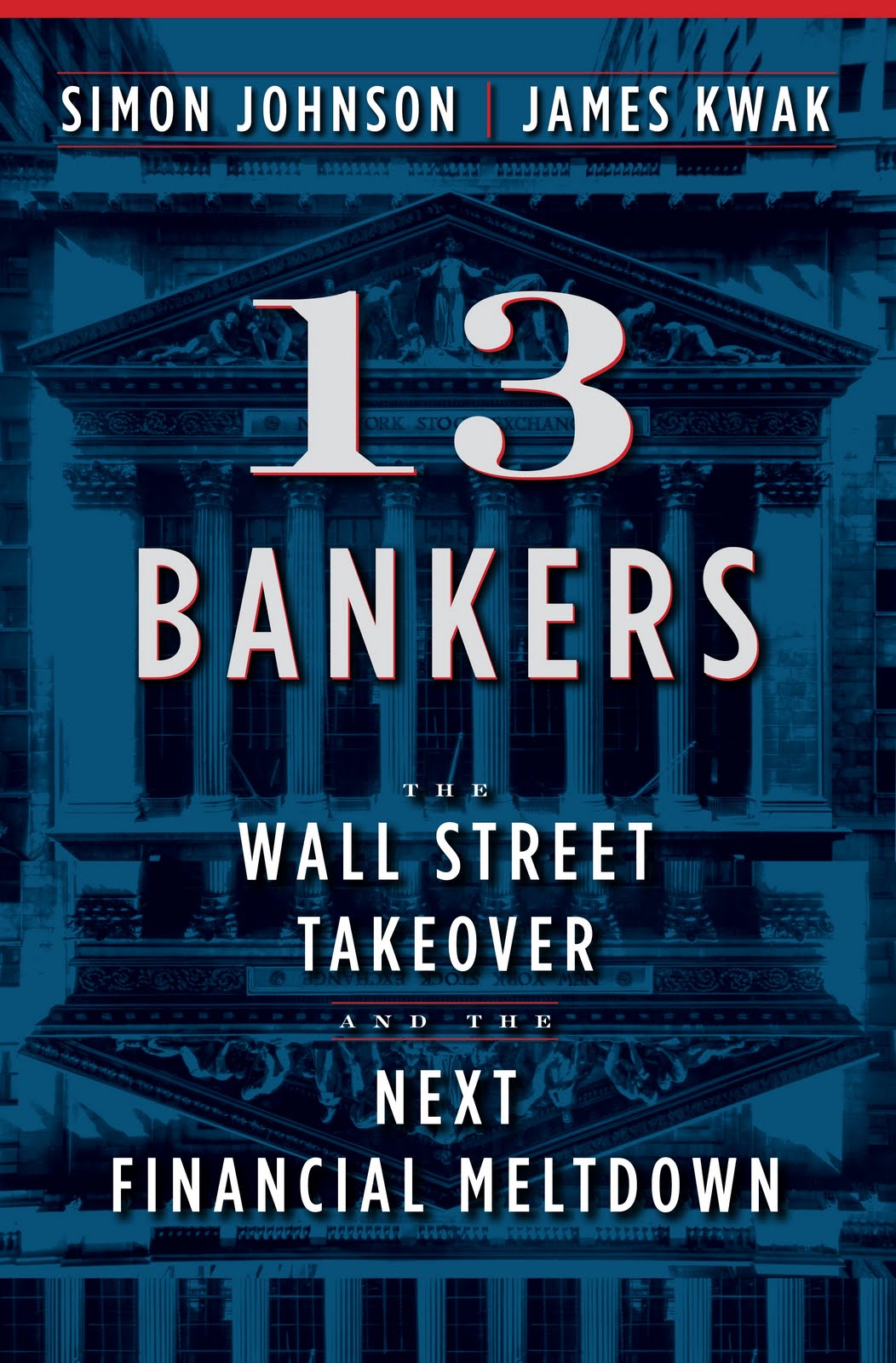
Johnson and his co-author James Kwak, celebrated bloggers with "The Baseline Scenario" (http://baselinescenario.com/) and now with The Huffington Post, have just published a cri de coeur to bust up this cozy political arrangement, which the authors say extends to both major political parties. In 13 Bankers: The Wall Street Takeover and the Next Financial Meltdown (Pantheon, $26.95) the authors argue: “If you hid the name of the country and just showed them the numbers, there is no doubt what old IMF hands would say: nationalize troubled banks and break them up as necessary.”
Socialism! Anarchism! And shades of Alan Greenspan, who not so long ago commented that if some banks today are "too big to fail...they're too big."
So what would be an acceptable size for the six megabanks (Bank of America, JP Morgan Chase, Citigroup, Wells Fargo, Goldman Sachs, and Morgan Stanley)? These authors say none should probably have assets exceeding 4% of GDP, or roughly $570 billion in assets, and no more than 2% of GDP, or $285 billion, in the case of investment banks. Pretty reasonable I'd say.
For my full review go to: http://www.dailyfinance.com/story/books-daily-finance-too-big-to-fail-too-big/19422136/
Sunday, March 28, 2010
Knowing Without Knowing
In 1913, Sigmund Freud wrote about "the strange behavior of patients in being able to combine a conscious knowing with not knowing" -- and went on to dramatically demonstrate the behavior personally, since he was diagnosed with cancer yet continued a habit of incessant cigar smoking. Beginning in the 1920s, Freud got regular reminders that he was risking death: He underwent more than 30 surgical operations to have precancerous growths removed from his nasal and oral cavities.
This Verleugnung, as Freud called it, or "denial," is also common in the business world, says Harvard Business School historian Richard S. Tedlow. The behavior pattern was there when Henry Ford refused to acknowledge the signs all around him that car buyers were no longer satisfied with a one-size-fits-all Model T. It was there in the 1960s when Sears refused to take notice of the emergence of such discount retail chains as Target, Wal-Mart -- and Kmart, the company that would absorb the once proud Sears in 2005.
Tedlow's new book, Denial: Why Business Leaders Fail to Look Facts in the Face -- And What to Do About It is a provocative and enjoyable reflection on numerous business blunders and successes. These aren't just errors in judgment, mind you. They occur when executives avert their eyes from a reality of which they cannot but be aware. My review of Tedlow's book can be found at: http://www.dailyfinance.com/story/company-news/books-daily-finance-facing-up-to-the-awful-truth/19411308/
Wednesday, March 17, 2010
More on Michael Lewis' Book
Reuters has a very interesting video q&a with Michael Lewis, now on its website. You can find it at: http://live.reuters.com/Event/Live_chat_with_Michael_Lewis
Thursday, March 11, 2010
Eyesight to the Blind
Henry Paulson admits he didn't see the meltdown coming. In his memoir On the Brink, the former Treasury Secretary describes a 2006 meeting of the White House economic team at Camp David, where he warned of the possibility of a coming economic "disruption," which he said was overdue. But, he adds, "I misread the cause, and the scale, of the coming disaster. Notably absent from my presentation was any mention of problems in housing or mortgages."
So if Paulson missed it, and Treasury Secretary to-be Timothy Geithner missed it, and Fed chairman Ben Bernanke missed it...who saw the cataclysm coming?
In the words of Michael Lewis, only a handful of unusual, “almost by definition odd” outsiders were able to look past the conventional wisdom and see the subprime-mortgage-inflated market for what it was. Lewis profiles this tiny group who were able to "see the ugly facts and respond to them" -- and thereby make a killing even as most of Wall Street was decimated--in his new book, The Big Short: Inside the Doomsday Machine (Norton, $27.95). My review of this very informative and, believe it or not, entertaining book appears today on Reuters at http://blogs.reuters.com/great-debate/2010/03/11/michael-lewis-big-short-an-unsettling-experience/.
As is common with Lewis, there are some funny bits -- but given the subject matter, the volume could hardly be a laugh riot. After all, fortunes were destroyed and many, many people were financially ruined. Still, consider this passage, where the author describes his protagonists' hunt for the worst subprime-mortgage-backed bonds, which they were preparing to short: “Looking for bad bonds inside a CDO [or collateralized debt obligation] was like fishing for crap in a Port-O-Let: the question wasn’t whether you’d catch some but how quickly you’d be satisfied you’d caught enough.”
That's typical of Lewis's not-for-family-hour prose. Darkly funny stuff. And also highly insightful. For a writer who made his reputation on claims that he knew nothing about nothing when hired to work on Wall Street in the '80s, somehow Lewis has learned a great deal about some very sophisticated investing.
Subscribe to:
Posts (Atom)